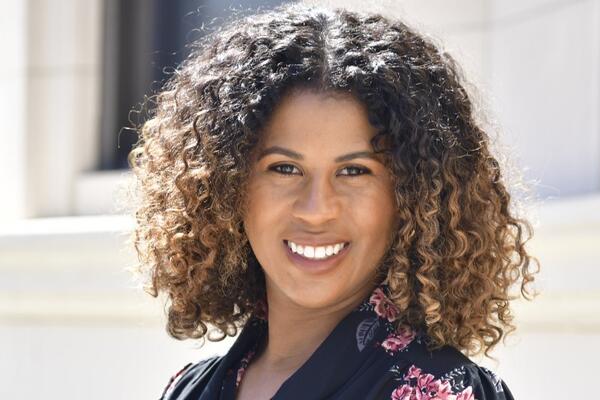
Brundage-Moore, a trailblazing environmental advocate, legal scholar, and educator, brings a dynamic blend of litigation expertise, community-driven advocacy, and clinical teaching experience to this newly established role.
The Yale Center for Environmental Justice (YCEJ) today announces the appointment of Asha J. Brundage-Moore as the Director of the new Collaborative Clinic for Nonprofit Viability, a pioneering initiative designed to support grassroots and frontline environmental justice and indigenous organizations in navigating legal, organizational, and strategic challenges.
YCEJ is a joint center spanning Yale Law School (YLS), Yale’s School of the Environment (YSE), and Yale’s Center for Race, Indigeneity and Transnational Migration (RITM). The clinic will leverage these with at least two other partner law schools and private firms to defend and empower environmental justice organizations and other community-based organizations facing an intensifying array of legal and political threats. The first practicum launched with Yale Law students this fall and will deploy as a full clinic in January, and the Clinic’s work on non-profit viability is closely allied with the Environmental Justice Clinic already offered at the Law School.
In addition to her leadership of collaborative efforts that span multiple schools, legal service organizations, and private firms, Brundage-Moore will collaborate across the university to integrate experiential learning opportunities that connect students with the lived realities of environmental justice advocacy. Her work will be pivotal in expanding YCEJ’s capacity-building efforts to defend and strengthen community-led organizations confronting disproportionate environmental burdens.
“Years ago, Asha was a brilliant student of mine. Today she is a leader in clinical practice and education, and is informed by a decade of practice that will inform her approach to instruction and impact,” said Gerald Torres, YCEJ’s Founder and the Dolores Huerta/Wilma Mankiller Chair Professor of Environmental Justice. “She understands that law is a technical discipline, but that it inhabits a moral universe to ground its legitimacy. We are fortunate to have her with us.”
Brundage-Moore joins YCEJ from the University of Denver Sturm College of Law, where she served as a Christopher N. Lasch Clinical Teaching Fellow in the Environmental Law Clinic. There, she supervised students in state and federal litigation, administrative proceedings, and community lawyering, while forging partnerships with environmental justice organizations across Colorado. Her work focused on strengthening nonprofit capacity, securing environmental protections, and advancing legal strategies rooted in community empowerment.
A graduate of Stanford University and the New York University School of Law, where she was a Root-Tilden-Kern Public Interest Scholar, Brundage-Moore has built an impressive career spanning environmental litigation, public interest law, and policy advocacy. She has held roles with the Animal Legal Defense Fund and New York Lawyers for the Public Interest, where she developed and litigated cases addressing environmental harms in frontline communities. She has authored amicus briefs in landmark climate litigation, including cases focused on children’s environmental rights and state constitutional protections.
Raised in Hawaii and Oakland, California, Brundage-Moore’s passion for environmental justice is deeply personal, shaped by firsthand experiences with environmental inequities and community resilience in the face of systemic disinvestment and threats from climate change. Her career reflects a steadfast commitment to defending the rights of marginalized communities, fostering nonprofit sustainability, and preparing the next generation of public interest lawyers to tackle pressing environmental challenges.
“I am thrilled to be joining the YCEJ team and leading the Collaborative Clinic for Non-Profit Viability. I look forward both to supporting and empowering environmental justice and indigenous organizations in the vital work they do and to introducing students to how to use their legal skills to defend and strengthen them”, says Brundage-Moore.
“This clinic was born directly out of concerns for organizational viability that communities flagged for us at last year’s Environmental Joy conference, held two days after the last US presidential election,” said Michel Gelobter, YCEJ’s Executive Director. “We’re grateful for the collaborative relationships we’ve been able to develop with legal practitioners around the country and are grateful for the opportunity to bring the value of one of our country’s pre-eminent law schools to the table in this critical time.”
About the Yale Center for Environmental Justice
With the world’s largest, single-campus environmental justice faculty and courses, YCEJ works through education, research, and policy analysis to co-create solutions for a more just and sustainable world. YCEJ’s programs are guided by an Advisory Board of distinguished leaders in academia, policy, philanthropy, and advocacy.